
Lecture for the Department of Religion & Cross-Cultural Studies, Universitas Gadjah Madha (Yogyakarta, Indonesia). Further iterations presented at The Substation Arts Center (Singapore) and ETH Future Cities Lab (Singapore).
~
A visual survey of an imagined landscape.
Visualising Paradise is a lecture/survey looking at the construction of an imagined landscape.
It spans across different time periods, geographies, theological and philosophical ideas, as well as image-making in fine art, map-making and films. The lecture reflects on various ideas of paradise (as a physical space), as well as Western historical obsession of discovering paradise within the lush equatorial zone.
The materials are presented in 4 chapters: Desire, Miracle, Creation, and Ghosts.

Speculating the physicality of Paradise is one of the longest continuous discussion of an imagined landscape.
Where is it located?
How does this promised eternal space looks like?
This long conversations of Paradise can be a tool to reflect how we imagine nature and how this spiritual (and sometimes voyeuristic or super-terrestrial) visualisations is defined by the real world, our own culture, new scientific discoveries, or as ways to search for lost tradition.
10 September 2016, SURVEY at The Substation Arts Center.
~
(Transcript)
Speculating physicality of Paradise is one of the longest continuous discussion of an imagined landscape. Where is it located? How does this promised eternal space looks like? This long conversations of Paradise is an attraction for me; as a way to reflect how we imagine nature and how this spiritual (sometimes voyeuristic or super-terrestrial) visualisations is define by the real world, our own culture, new scientific discoveries, or as ways to search for lost tradition.
With this, let us go for a “walk” – sometimes factual and sometimes with our own imaginations – looking at various paradises through paintings, maps and films.
I hope these materials will manifests into new imaginations of looking and experience of our surrounding landscapes.
Introduction
I started this accidental collection of images as a reaction to some things that itched me. One is that i will like to discover again the language of the tropics. My profession is a european invention, the ideas of gardens and leisure, the past references, the typologies, ways of looking at landscapes and also the motivations are essentially build on european ideas of the city and nature. I’m not saying its bad but maybe in the tropics there can be an autonomous “next step”, just like in tropical modern architecture
This makes me excited. Culturally i feel Southeast Asia is so weaved together in time, there are so many ideas of landscapes and stories that were hidden because of modernity that slowly we are re-discovering them.
Maybe talking about Paradise is a door and instigator to open up to imagines of tropical ideas of landscape architecture.
So this conversation, I will try to show my fascination of a variety of paradise, from the perspective of design, architecture, art history, mythology, religion. You can also read it anyway you want. Because as no one had any experience of Paradise in real, so essentially I’m talking speculatively and you will see what you want to see. And maybe after this we can have nice conversations.
1. Desire
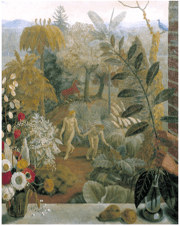
Desire is important character of paradise. For me, maybe the whole idea and energy to imagine a promised landscape is about the desire to find something. I can say that the visuals collected can be categorised by two kinds of desires.
One is that the paradise is a tool to imagine and explore new worlds or ideas. To feel the future. This I find comes from the european tradition but also some from the images commissioned by kings or emperors.
Another reading of the visuals is as a way to discover again lost traditions. Maybe this category is more for Asian ideas of paradise. This can be personally felt trying to dig up images of old Singapore or images from pre-colonial South-east asia. I think with the past history of this region, desire to recreating paradise is important tool of re-discovering.

2. Miracle
gushing water in the desert,
journey to the skies,
holiness descends on earth
I guess paradise cannot be a normal space.
The following images try to show variations of miracles. From the sensational to the banal, the miracles from acts by earthly actions and from the skies. The re-experience through pilgrimage walks and the rituals, and the time-space coordination when the earthly and cosmological meets.
(List of accompanying images)
Bagh-e Shahzadeh, Iran _ Georg Gertster 1977
Garden Beni Hassan Egypt, 2300BC
Reproducing Ancient Egyptian Painting, Chicago, Nina M. Davies,1936.
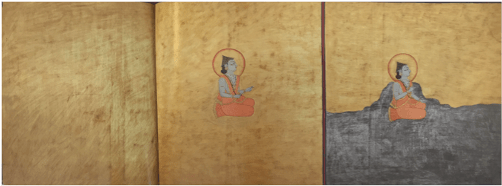
The Mahasiddha Jallandharnath At Jalore, 1805
Cloud Island motifs frontpiece, Lotus Sutra scrollls, 1163
Time and space cycle in relation with Mayan festival cycle
T’ai Shan Mountain
Vishnu and Lakshmi in their heavenly palace, 1755 miniature
Pilgrimage routes, Braj
3. Creation
yearning for divinity,
the puzzle of location
looking for a forgotten past.
How can we imagine a place where no one has been to?
This puzzle manifested in so many beautiful ways; from the logic of mathematics, astronomy, navigations technologies, visual sequences, maps in space and time, and re-enactments of past paradises.
(List of accompanying images)
Zero, Islamic geometry
Cupola of Macarabes, Alhambra
Cloister Van Der Laan
The Emergence Of Spirit & Matter, 1828
Engraved copy of a 5th century mosaic, Giacomo Bioso, 17th century
Johannes Gmunden, Table of Latitude & Longitude, 1436-1439
World Map, Frau Mauro, Venice, 1450
The Probable Garden OF Eden: A Long Forgotten Star Myth, James E Nicholson, 1935
Map Of Eden As Center Of The World, Chris Ward, 1998
Twelve light forms manifestations of Nathji, 1823, Mehrangarth Museum trust
Adam and Eve in the Garden of Eden, 1615, Jan Brueghel
Jungle of Singapore, Unknown
Ten Thousand Tigers, Ho Tzun Yen
Woodlands, Long Gores, Marietta Pallis
Marshes, Long Gores, Marietta Pallis

4. Ghosts
communicating with the other…
meeting with another world,
invoking and healing.
Looking at these images sometimes reminds me of ghost stories. I want to go a bit into ideas of Paradise as a way of healing. For the living recovering from lost, for the restless spirits trapped still in the earthly world, and also post-colonial or modern societies invoking past and lost landscapes as spaces of an ideal and meeting with lost connections.
(List of accompanying images:)
Adrian Collaert after Stradanus , 1590s
Nanha and Manohar, approx 1610s
Toa Payoh Banyan Tree, Singapore
Masjid Kampong Sembawang, Singapore
Scene of Honen’s cremation
Order and ritual of cremation site, Yoshimitsu
Archery, Buddhist animal scrolls, Kozanji Temple mid 12th century
Harimau Kidang Bali, 1960s
Teardrop On Lotus Leaf, Abanindranath Tagore, 1912
So with all these speculative talk and images, we go back to the first question – Where is Paradise?
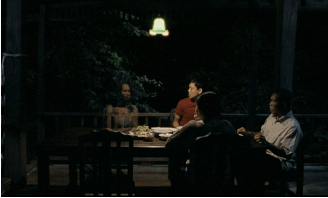
In the film “Uncle Boonmee Who Can Recall His Past Lives”, there is a scene where the spirit of his deceased wife appears in the middle of dinner time. After the expected initial shock of someone other-worldly appearing suddenly, the conversations becomes normalise, each asking the other about their lives and well-being.
For me, this is a relatable way to define the spiritual and Paradise. Not so much as a promised eternal space, but as another world that is living together with the real world. Once in a while we will meet and maybe interact. So if I force myself to define where and how Paradise looks like, the chance to find it may be in places where there is high population of the “other world”.
Therefore, i will like to end this walk with a hint from a Korean shaman.
“Where do the spirits stay?”
“They like to live near clean waters?”
 stable unstable